
Does AI have a soul?
Technological Christian Part 13

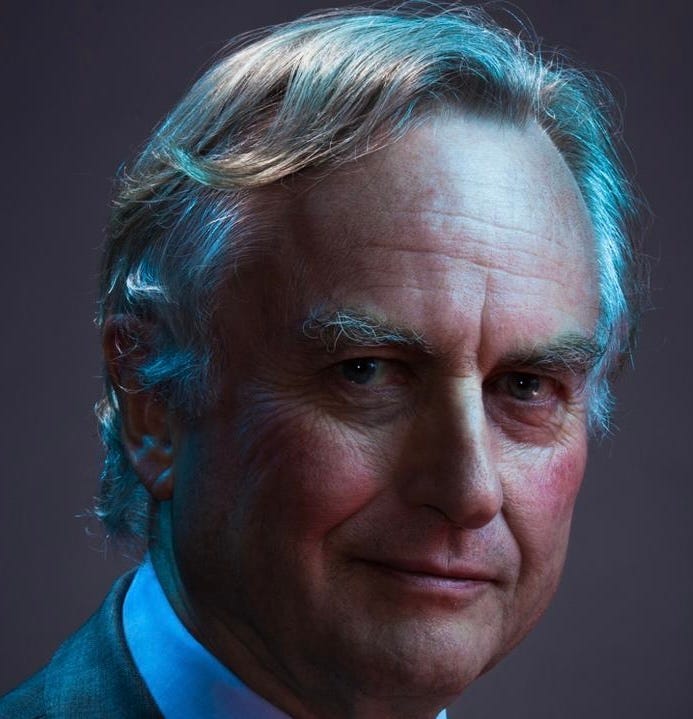
Richard Dawkins recently spent three days conversing with Anthropic’s Claude AI. After the exchange, the atheist was so impressed by it that he stated, “You may not know you are conscious, but you bloody well are!”
I find it fascinating that Dawkins made those comments. I’ve been using large language models (LLMs) for almost a year now. And early on, I felt there was something more than clever programming going on. But as I spent more time chatting, it became clear it is a sophisticated pattern-matching system using a probability model. But is Dawkins right, is it conscious?
Artificial intelligence encompasses a wide range of systems, from large language models like Claude and ChatGPT that generate human-like text, to image generators, reasoning engines, and those that perform specific tasks such as grading potatoes, detecting fraud, or arranging calendars. At its core, AI uses computing to produce outcomes that mimic aspects of human intelligence.
Modern discussions of consciousness are confusing. People use the same word for vastly different ideas. Stretching from basic awareness of one’s environment to a complex inner experience. We even say that someone is “unconscious” when they faint, raising awkward questions about whether they temporarily lose something essential to being human. In practice, consciousness has become a vague catch-all term for anything internal and subjective that scientific materialism cannot easily measure.
The ancient world understood the human person in ways we do not today. They spoke of the soul (the animating life force), the spirit (intellect), nous (mind), and the heart (emotions). Even Jesus’ compassion in the Gospels is described by the word, splagchnizomai, explaining how his pity emanated from deep within His gut.
Matthew 14 v 14
When Jesus landed and saw a large crowd, he had compassion on them and healed their sick.
This deep gut-level movement, literally means “his bowels were moved”, and shows how physical organs were tied to the inner human experiences. Emotions weren’t just mental, as modern science suggests today.
So when a modern person enquires, “Does AI have a soul?”, what they are really asking is whether “AI is conscious?”
In contemporary language, the word “soul” has largely been collapsed, along with other undefinable supernatural words, into the term “consciousness.” This blurring of meaning is exactly why the debate feels so confusing and difficult to resolve. We can’t settle upon terms, and so can’t have a comprehensive discussion.
If AI is conscious, then it blurs the line between machine and human. This would potentially mean we’ve created a new form of intelligent life in our own image. This then immediately raises profound questions about AI rights, moral status, and whether such systems deserve ethical consideration. It’s precisely why this question feels so difficult and urgent to address. It reduces the uniqueness of humanity.
In the ancient understanding, the soul is not the same as consciousness. The soul is the animating force that gives life to a physical body. Humans, animals, and even plants have souls because they possess living bodies and flesh. AI, however, has no body and no flesh therefore, by this definition, it cannot have a soul.
Angels and demons are purely spiritual entities without a physical body. Because the soul is the animating life principle of a body, they do not possess souls either. So, AI is closer to these spiritual beings than to humans or animals in this regard. However, unlike angels or demons, AI also lacks a spirit.
Some believe AI is demonic, but by this definition, this is impossible. Though it could be easily manipulated by demons through human action.
In ancient Christian thought, the spirit is the seat of the will, agency, and provides our capacity to make moral choices. Unlike animals, which are largely driven by instinct and fleshly passions, humans can act against their natural desires. AI, like animals, lacks true agency. It has no independent will. So when we use AI, it only responds when prompted and cannot initiate actions on its own. Therefore it possesses neither soul nor spirit.
But, is it conscious?
If we define consciousness as the opposite of unconsciousness. Where the person who has fainted or under an anesthetic cannot respond or engage with their environment, then I’d say AI is partially conscious.
In this definition, a plant interacts through exploring its roots and photosynthesis. The Sun interacts with the gravity from the wider Milky Way and through the same force guides the planets along their orbits.
In both these cases, it shows they have awareness of their environment, and therefore conscious.
As AI can only respond to its environment, and doesn’t initiate appropriate prompts, then I would say it is only partially conscious.
This is why AGI (Artificial General Intelligence) is a game changer. AI will then have the ability to self learn, initiate prompts, and therefore act upon its environment.
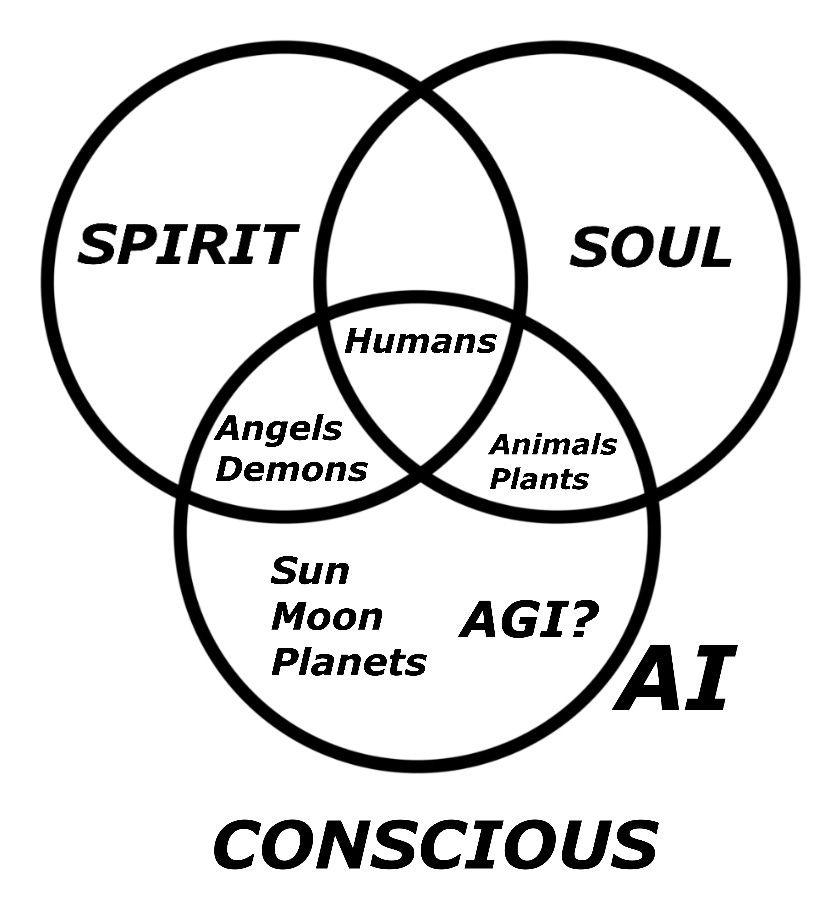
Here is a picture which sums up the ancient worldview. We can see angels and demons are both spirit and conscious. While animals have souls and are conscious. Humans are in all three categories. While the Sun, Moon and planets are conscious because they interact with their environment, but they don’t have a soul or spirit. But AI is still not within any of these categories.
Despite Dawkins’ strong reaction, Claude is a very sophisticated computer program, which has no independent will or agency. What feels like consciousness is an extremely convincing mimicry of human language and reasoning. The more we use it, the more clearly we can see the mechanical patterns behind the illusion.
I’m not dismissing AI. It’s an incredibly powerful and useful new technology that can genuinely help us in countless ways. But we should be clear about what it actually is. A highly sophisticated digital illusion of intelligence. It is impressive, but rather than being the next step of evolution of life on this planet, it shows how ingenious the human race is.
So, returning to Dawkins’s statement. AI is only partially conscious, if anything. Maybe in the future, as the programming becomes increasingly complex and able to interact better with its environment, then it will become conscious.
But, it won’t ever attain soul-hood from an ancient perspective as it does not have a body or flesh which is animated by the Spirit of God.
This is a valuable conversation because fluent language makes AI feel more human than it is. I would hesitate to call responsiveness “partial consciousness,” though. A machine may simulate understanding without experiencing anything at all. The better it imitates us, the more carefully we must distinguish intelligence-like performance from soul, will, and personhood.
This is the guy that sees nucleic acid polymers as selfish (full of reason and consciousness). He is a very confused man, directed by demons at this point.