
Reflection: Psalm 133

I recently attended a memorial service for my father. My Dad died two years ago, and we had a short graveside service to dedicate his headstone. It was unsurprisingly well attended, as he was a church warden and a popular character in the village.
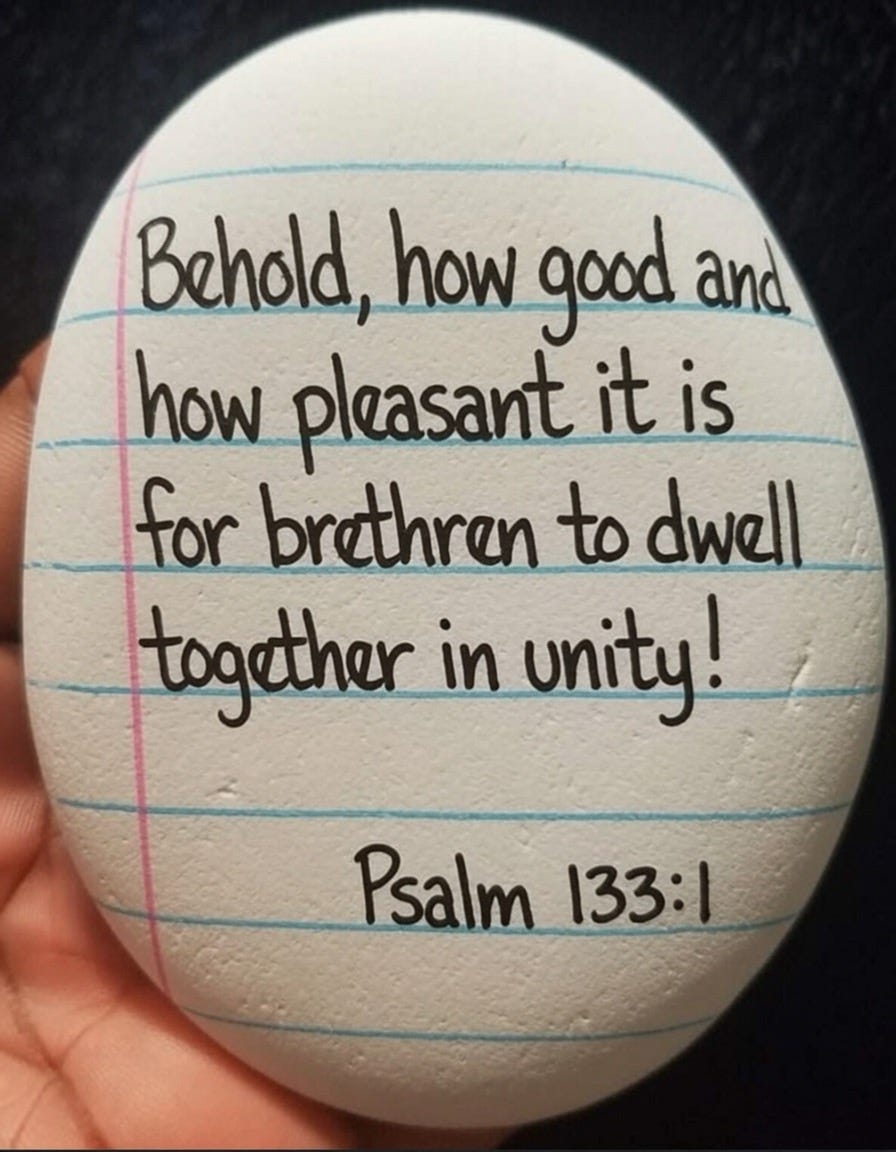
The final reading of the ceremony was Psalm 133. It is the shortest psalm in the Bible.
Psalm 133
A song of ascents. Of David.
How good and pleasant it is when God’s people live together in unity!
It is like precious oil poured on the head, running down on the beard,
running down on Aaron’s beard, down on the collar of his robe.
It is as if the dew of Hermon were falling on Mount Zion.
For there the Lord bestows his blessing, even life forevermore.
It is a psalm which calls for unity in Israel. As we know, the kingdom split into two around 930 BC, the Kingdom of Israel and Judah. Israel was eventually destroyed by the Assyrians, and the Jews were taken away into captivity in Babylon.
The psalm itself is beautifully poetic, and draws on vivid imagery. We can imagine the anointing oil flowing over the head and beard of Aaron, the first high priest. This refers to Exodus.
Exodus 29 v 7
“Then take the anointing oil and pour it on his [Aaron’s] head and anoint him.
The reason the psalmist uses this incident is because Aaron is seen as the person at the centre of the worship of God in ancient Israel. The purpose of anointing was to set apart a person or object for God’s holy purpose. In Exodus, Aaron is set apart as the high priest.
But in Psalm 133, the anointing oil doesn’t stop at his head, it flows out onto his beard, and towards the edge of his robe. Or symbolically beyond the priesthood itself.
We then have a strange image of the dew of Mt Hermon is the same as that which falls on Mt Zion. This makes more sense if we understand this from a spiritual perspective.
Mountains were seen as the home of the gods in the ancient world. For example, we all know the Greek gods lived on Mt Olympus. So as Hermon is the tallest mountain in the region, at over 9,000 feet, it is spiritually the nearest peak to Heaven.
So the psalmist is saying that the closeness of Hermon to the Heavens is the same as Mt Zion. Even though it is lower. And it is here God gives his blessing. The place where not only He provided a ram caught in the thicket for Abraham, but where Christ gave up His life for us, and opened the door to life everlasting.
As I listened to my friend Christopher read the psalm at the graveside, I wondered why it had been chosen. It’s not a psalm which immediately jumps to mind when we think about death.
However, when he spoke the last line, it clicked. Even though we were standing around a grave in a churchyard, I saw the anointing which consecrated Aaron, set this place apart too for Christ. Graveyards are a place of mourning, but with Him they become a place of hope and remembrance, pointing to the resurrection and life everlasting.
If you like this article then please consider subscribing to receive more into your inbox.
If you enjoyed it, then I would encourage you to share it with your friends and family.
The AI image I used for this article is based upon a format posted on SubStack by Give me Jesus
A common Irish headstone inscription; "Death leaves a heartache no one can heal; love leaves a memory no one can steal."